Skip directly to content

SPIRITUAL: Holy Day

6:15 am Monday, February 22, 2016

The Eight Mahayana Precepts are a set of eight vows taken for a period of 24 hours, from sunrise on one day to sunrise the following day. The vows include no killing, stealing, sexual activity, lying, sitting on high beds, taking intoxicants, wearing perfume or jewelry, or eating after noon. Our Spiritual Director, Lama Zopa Rinpoche, encourages students to take the Eight Mahayana Precepts on holy days.

Join us for the power of group practice to take the Eight Mahayana Precepts, followed by a light breakfast, on the celebration of the Day of Miracles, the culmination of the two-week Great Prayer Festival.

The first time a student takes these precepts it must be from a qualified teacher. Those who have taken precepts previously from a qualified teacher can join us at the Kadampa Center or take them at home, at “first light”.

Location at Kadampa Center: 
Gompa
Monday, February 22, (All day) 2016

The two-week long Tibetan Great Prayer Festival, Monlam Chenmo, which began with the Tibetan New Year, culminates in the Day of Miracles, which falls this year on Monday, Feb. 22nd. As a Buddha Holy Day, the karmic effects of virtuous actions performed on this day are multiplied exponentially, according to Lama Zopa Rinpoche. 

Kadampa Center Schedule of Events

6:15  am    Eight Mahayana Precepts, followed by a light breakfast and a group
                   reading of  The Vajra Cutter Sutra

12 pm        Medicine Buddha Puja

At 7 pm our regularly scheduled Discovering Buddhism class will meet.
In addition to the scheduled events the Center will be open all day so students can come and do practices, either individually, or as a group.

The FPMT spiritual director, Lama Zopa Rinpoche, encourages students to take the Eight Mahayana Precepts on holy days. Those who have taken precepts previously from a qualified teacher can take them at the Center, or at home, at “first light”.

Other Recommended Practices on Holy Days:

Reading The Golden Light Sutra, Confessions to the 35 Buddhas, or any other Saddhana, Mantra, or “heart practice”
     
Other ways to create merit:

  • To make the day even more powerful dedicate all your positive actions to the benefit of all sentient beings.
  • Be mindful to take advantage of opportunities to practice acts of kindness and generosity towards all sentient beings, including family, friends, strangers, co-workers, “enemies”, and animals.
  • Rejoice in all the positive actions of oneself and others.
  • Rejoice in recognizing and avoiding any occasion to experience irritation, impatience, anger, envy, jealousy, laziness, or any other negative emotion.
  • Purify any negative action of body speech and mind extensively.


More about Monlam Chenmo and the Day of Miracles

Monlam Chenmo is a two-week period during which the Buddha performed various miracles. The two weeks of holy days are observed with the Tibetan Great Prayer Festival beginning on Tibetan New Year, and, on the final day - the Day of Miracles - many fesitvals and rituals are held.

The Great Prayer Festival was established in Tibet in 1409 by Lama Tsongkhapa to commemorate Shakyamuni Buddha’s performance of miracles at Shravasti. According to the Sutra of the Wise and Foolish, six great Hindu teachers, representing the six great schools of Hinduism, challenged Shakyamuni Buddha to a competition of miracles. Typically the Buddha purposely avoided displays of powers because people are easily interested in mundane powers instead of practicing Dharma. However, through his clairovoyance, he understood they wouldn’t be subdued unless he performed the miracles, so he outdid them for 15 days, and the six scholars converted to Buddhism. The main purpose of the Great Prayer Festival is to pray for the long life of all the holy Gurus of all traditions, for the survival and spreading of the dharma in the minds of all sentient beings, and for world peace.

The Day of Miracles is an auspicious day for prayer and practice, as the karmic results of positive actions are multiplied exponentially. Students are encouraged to devote some special time to engage in positive actions, and heart practices; to rejoice in the positive actions of others throughout the world on this day, and to dedicate the merit to the benefit and eventual enlightenment of all sentient beings.

Our Spiritual Director, Lama Zopa Rinpoche, encourages students to take the Eight Mahayana Precepts on holy days. For more about the practice of precepts, please read The Direct and Unmistaken Method by Lama Zopa Rinpoche. Rinpoche advises many other practices on holy days as well.

Since the holy days are based on the Tibetan lunar calendar, according to our Western calendar they fall on different days every year. Please see our calendar for specific dates and a schedule of events.

Location at Kadampa Center: 
Gompa
12:00 pm Tuesday, November 3, 2015

Making offerings to holy beings is a powerful way to create merit, and creating merit is a powerful way to remove obstacles to spiritual progress.

On this auspicious holy day, we will make extensive offerings across the width of our altar, in preparation for saying the Shakyamuni Buddha puja in the evening.  Because this is a merit-multiplying day, the merit we collect by making offerings will be increased exponentially.  How wonderful!

Please come join in, starting at noon, to create an amazing array of offerings!


Location at Kadampa Center: 
Gompa
Saturday, December 5, (All day) 2015


Lama Tsongkhapa (1357-1419), the founder of tour own Gelugpa tradition, is renowned as a great scholar, practitioner, meditator, teacher, and author. Among his many accomplishments, he revitalized the monastic code in Tibet, established the annual Great Prayer Festival, established Ganden Monastery, the first of the great monasteries in the Gelugpa tradition, and wrote 18 volumes of teachings, including his Great Treatise on the Path to Enlightenment, the Lamrim.

At Kadampa Center we will have several events to mark the day.

At 3 p.m. we will do a special practice of reciting the Kshitigarbha mantra.

Lama Zopa Rinpoche has advised doing this practice as much as possible before February, to pacify the possibility of earthquakes in California and Nepal. As
always, when we gather in a group for practice, the combined energies of everyone together multiplies and increases the power of our practice, so do come
and join in this special event.

At 4 p.m., immediately following the mantra recitation, we will have Guru Puja with tsog.
In Guru Puja, we reflect on and celebrate the good qualities of all our teachers -- and Lama Tsongkhapa is such an important lineage teacher for us! This
beautiful practice includes many stanzas meditating on key points of the lamrim.

After the Guru Puja, at about 5:30 p.m., we will do a light offering practice and offer lights at the stupa.


Location at Kadampa Center: 
Gompa
5:30 am Saturday, August 8, 2015

Seven weeks after attaining enlightenment at Bodhgaya, the Buddha gave his first teaching at the Deer Park in Sarnath. He expressed his profound realization of the nature of existence in the Four Noble Truths:

    The Truth of  the Nature of Suffering
    The Truth of the Origins or Causes of Suffering
    The Truth of the Cessation of, or Liberation from, Suffering
    The Truth of the Eight Fold Path as the means to attain ultimate happiness and freedom from suffering.
This teaching, referred to as the First Turning of the Wheel of Dharma, led to the formation of the Sangha, the community of disciples committed to following the Buddha's example of living simply, following the Path, and teaching the Dharma.

 Kadampa Center's Observance of the First Turning of the Wheel, Chokor Duchen,  will include:

5:30 am   The Eight Mahayana Precepts, followed by a light breakfast, and a group reading of the Vajra Cutter Sutra.

The Center will also be open from 5 a.m. to 5 p.m., so that members can engage in individual practices in the Gompa, as their schedule permits.*

*********************************************************************************

*Lama Zopa Rinpoche notes that on a Buddha Holy Day such as Chokor Duchen, karmic consequences are multiplied 100 million times, according to a Vinaya text.

Center members who have previously taken the Eight Mahayana Precepts are encouraged to take them at the center, or at home.

Additionally, it is an auspicious day for prayers, practices, and meditations focusing on any aspect of the Mahayana path to enlightenment.

**********************************************************************************

Location at Kadampa Center: 
Gompa

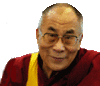
His Holiness the Dalai Lama - Birthday Celebration

We celebrate His Holiness' 80th birthday and have a discussion and practice on Compassion in Action.

Patrick McGinty and Erin Sloan led the program.

The videos shown during the celebration this morning are at Happy Birthday His Holiness!

7:00 pm Tuesday, June 2, 2015

Geshe Gelek will lead us in this powerful Vajrasattva practice, which is beneficial for purifying obstacles to spiritual development, negative karma and illness. It is the most powerful purification practice in daily life.   Purifying these negative and self-destructive habits allows space for positive experiences and beneficial states of mind to flourish in your life. 

This practice is very powerful for beginners and longtime practitioners alike, and for observers of all faiths.  Lama Zopa Rinpoche explains about the practice of purification: "The Vajrasattva purification practice, which is more powerful than negative karma, can prevent you from experiencing the problems that negative karma would otherwise bring you. If you don't want relationship problems, business failure, illnesses such as cancer or aids, notoriety, or the criticism of others, the practice of Vajrasattva is extremely important."

6:00 pm Tuesday, June 2, 2015

Geshe Geshe Gelek will offer a Refuge and Five Lay Vows ceremony. For details about these vows, please see this Mandala magazine article. The Five Lay Vows are lifetime vows, so only need to be taken once, and should be taken with the confidence you will keep them.

In order to participate, you must register here ahead of time.  The deadline to register is Sunday, May 31. Students who would like to refresh their refuge vows may come as well, but should not register.

Geshe Gelek recommends anyone interested in taking refuge should read the refuge section in the book Liberation in the Palm of Your Hand (available in our bookstore). He also taught a class on refuge in 2013 for students interested in the ceremony - you can listen to it in the recordings section of our website.

The ceremony will likely be in Tibetan, but it is first explained in English what you are saying. Please plan to be there at least 15 minutes before the ceremony starts. At the end of the ceremony, it is traditional to offer two katas (white offering scarfs, available in the bookstore) - one to the Buddha statue on the altar, and one to the teacher giving the vows, who returns it by placing it over your head as a blessing. While we often have spare ones to lend, it is best to buy them so you are actually making an offering of your own. It is also auspicious to give the teacher a gift, typically money (any amount) in an envelope, in appreciation for the incredible gift he has just given you with this opportunity. The center will also be giving you a copy of the FPMT booklet on refuge and how to practice it daily.

As with all our programs, we offer the Dharma and many resources freely to the community, and rely on your donations to cover the costs involved. Please consider supporting the center by making an offering in the donation boxes, through the bookstore, online, or by mailing a check.


7:00 am Tuesday, June 2, 2015

We will have a group reading of the Diamond Cutter (Vajra Cutter) Sutra as one of our practice that morning.

Geshe Gelek recommends that we begin reading the sutra at home on the first day of the month of Saka Dawa, May 19, in preparation for the group reading.

Download a copy of the Sutra from FPMT

5:15 am Tuesday, June 2, 2015

Join us for the power of group practice to take the Eight Mahayana Precepts, followed by a light breakfast, on the celebration of the Buddha's birth, enlightenment, and passing into parinirvana.

Saka Dawa is a holy day when karmic results are multiplied one hundred million times, as cited by our Spitiual Director, Lama Zopa Rinpoche, in the Vinaya text Treasure of Quotations and Logic. Rinpoche encourages students to take the Eight Mahayana Precepts on holy days. This is a set of vows that are taken for 24 hours, from just before dawn to the sunrise of the following day. 

The first time a student takes these precepts it must be from a qualified teacher. Geshe Gelek will give the vows on Saka Dawa. Those who have taken precepts previously from a qualified teacher can take them at home, at “first light”.

More Information
 

Pages